A basement that smells stale in July is usually reacting to humid air meeting cool concrete, while one that smells stale after rain is probably taking on groundwater. Either way, a meter reading beats guessing. Call the number on this page to be connected with a local mold company in Arlington Heights.
Mind the Utility Corner
Inspect the area around the furnace and water heater. Streaks of rust on a boiler, a wet pad under a tank, or a white crust on the adjacent wall can reveal seepage or a slow drip feeding mold on nearby lumber and cartons, sometimes unnoticed for a season.
Summer Air Meets Chilled Foundation Walls
Humid air drifting downstairs touches masonry that stays cold well into midsummer, and the moisture beads up on the surface. Cardboard, upholstery and lumber leaning against that wall absorb it, so corners and shelving areas often grow mold first. Shelving against the wall is the usual first victim.
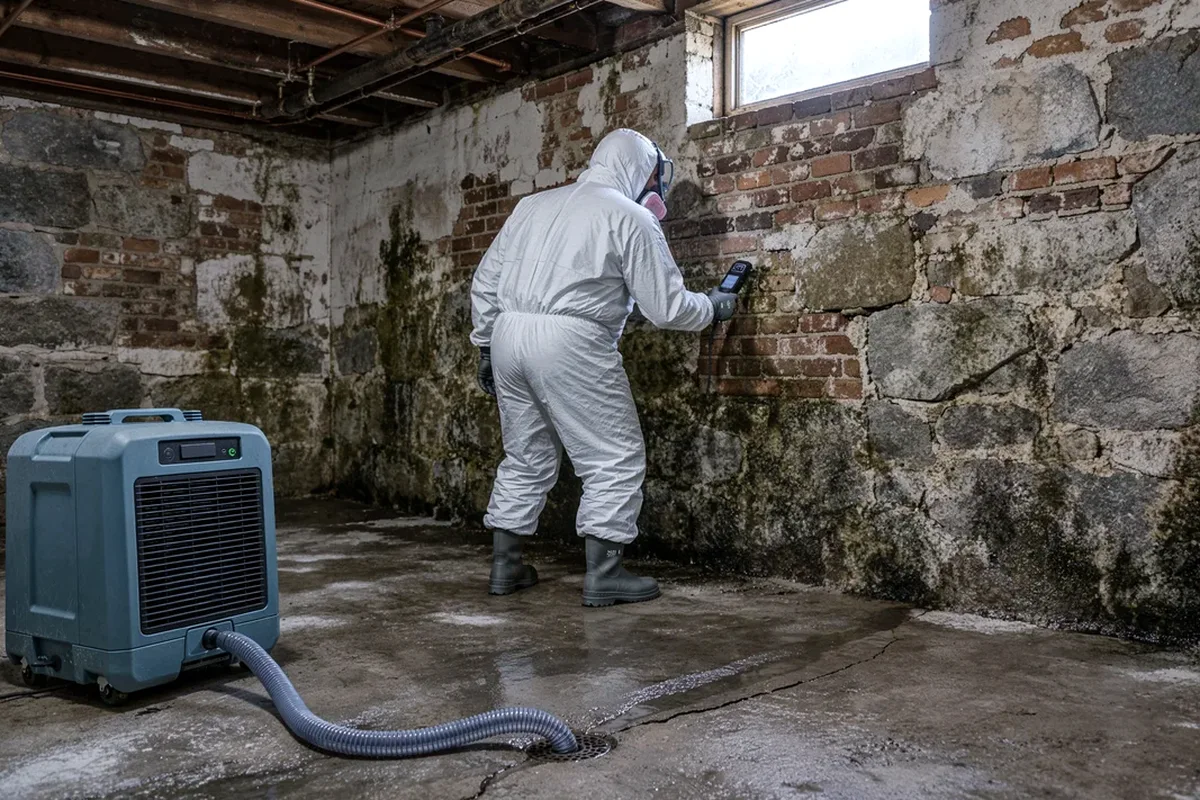
Houses from the 1970s, which describes many in Arlington Heights, often come with crumbling mortar, aging pumps and window wells that were never meant to handle modern cloudbursts.
Local details for Arlington Heights
Illinois asks mold remediation companies to register with the Illinois Department of Public Health under the Mold Remediation Registration Act. Ask for that registration before cleanup starts; IDPH does not license people who only do mold assessments or testing.
Keep the inspection report, the scope of work and any clearance results together; buyers, landlords and insurers often ask for them later.
Rebuild work after the mold comes out, such as new drywall or framing, may need a permit; the Village of Arlington Heights is where to ask for Arlington Heights addresses.
Water that came in from outside raises insurance questions; FEMA's flood map search shows whether the property sits in a mapped flood zone.
Companies that take calls here usually also work in Rolling Meadows, Mount Prospect and Prospect Heights.
Fixing the Entry Point
Mold work done while water keeps arriving is wasted effort. Grading changes, a window-well drain, wall sealing, a new ejector pit or a backwater valve may be handled by another trade at a separate price. Find out early what the quote includes. Ask who coordinates it all.
Keeping the Dust Downstairs
Stairs and ductwork connect a basement to the living space, so crews usually hang plastic sheeting, cover registers and run filtered air scrubbers. Ask how the furnace blower and return air will be managed while the work area is open to the rest of the house.
Work on the Yard, Too
Clean gutters, downspout extensions, soil sloped away from the house and patched cracks in walks and stoops frequently help a damp lower level more than any indoor product. During steady rain, walk the lot and notice where water gathers or runs toward the foundation. Small fixes add up.
More about Arlington Heights
Calls come in from across Arlington Heights, including around Arlington Heights Road, Northwest Highway (U.S. Route 14), Rand Road.
Lake Arlington is a human-made detention lake, part of how the village manages stormwater.
Basement Mold Removal questions in Arlington Heights
Why is there a stale odor when everything looks dry?
Can I scrub basement mold off myself?
Can a window well really cause mold downstairs?
Do older houses grow more basement mold?
More mold services in Arlington Heights
Basement Mold Removal nearby
Helpful guides
Sources
- Village of Arlington Heights Building & Life Safety Department
- Illinois Department of Public Health: mold remediation registration
- Illinois Department of Public Health: mold FAQs
- Illinois General Assembly: Home Repair and Remodeling Act
- EPA: A Brief Guide to Mold, Moisture and Your Home
- Arlington Heights housing by year built
- Arlington Heights: local background
Last updated: